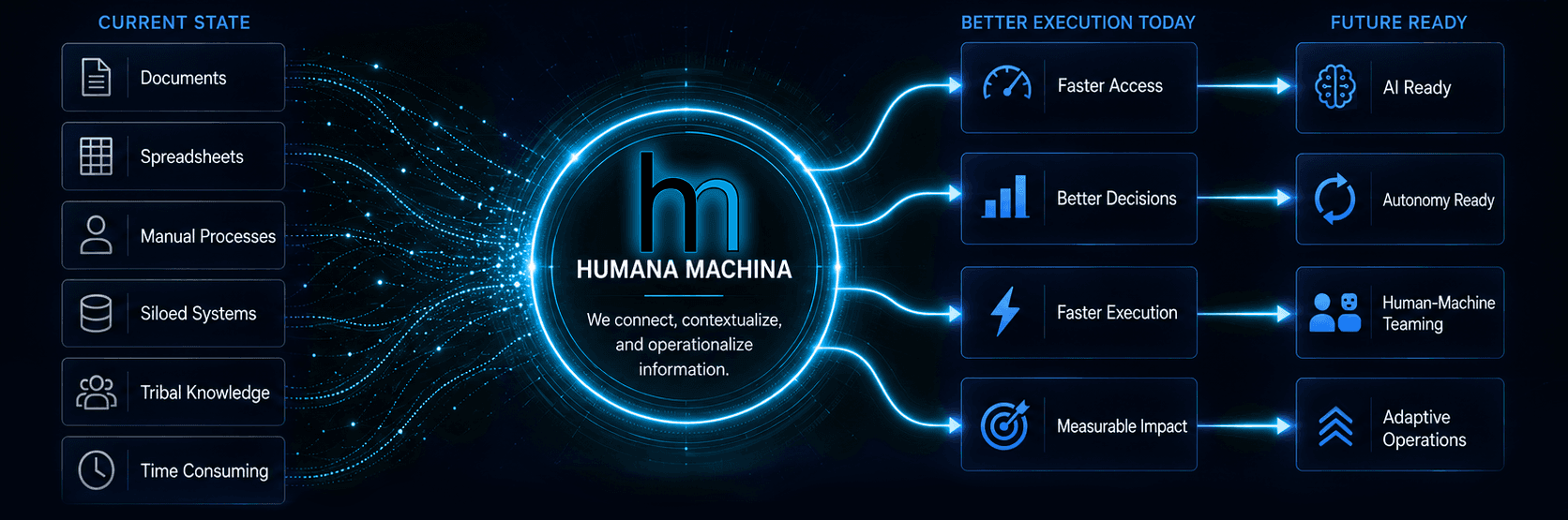
What We Do

Improve today.
Prepare for tomorrow.

Humana Machina helps organizations improve how work gets done today while building the foundation for a more adaptable human-machine future.

Humana Machina what we do graphic

What We Build

We build digital environments and workflow foundations that help organizations understand, maintain, inspect, train, and operate within complex physical systems. Our work connects spatial data, field knowledge, procedures, and decision-support tools into usable systems for people today and intelligent systems tomorrow.

The goal is practical: make operational information easier to use, preserve expertise before it disappears, and prepare teams for future human-machine collaboration.

Capability

Spatial Data Environments

We spatially collect accurate data of physical assets and reconstruct them into navigable 360-degree digital views. These environments help teams see the condition, location, and context of assets without needing to be physically present.

See Spatial Data Environments in Action
Spatially organized field data that helps teams understand assets before they arrive on site.
360-degree reconstruction that turns asset visibility into a shared operational reference.

Spatial data environments can support inspections, maintenance planning, training, documentation, remote collaboration, and future AI-enabled analysis.
Capability

Maintenance and Inspection Workflows

We help modernize maintenance and inspection workflows by connecting procedures, asset data, field observations, and spatial context. This gives teams a clearer view of what needs to be done, where work is happening, and what information is needed to complete the job.

These workflows can support technical procedures, inspection records, condition tracking, quality checks, and coordination between field teams, engineers, and decision-makers.

Maintenance and Inspection in Practice
A maintenance workflow demonstration that connects field activity to the information teams need to act.
Capability

Knowledge Capture Systems

Critical knowledge often lives in the minds of experienced workers, in scattered documents, or across disconnected systems. Humana Machina helps capture and structure that knowledge so it can be reused for training, maintenance, planning, and decision support.

Knowledge Capture in Practice
An inspector walks a ship space, calling out issues in real time while using the application to capture field knowledge as work happens.
That captured knowledge is then shown in the spatial environment, where observations become usable context for later review and action.

The goal is to preserve expertise before it disappears and make it available in the context where work actually happens.

Capability

AI-Ready Operational Data Layers

AI systems are only useful when the data beneath them is organized, contextual, and connected to real operational needs. We help prepare operational data so it can support future AI, automation, analytics, and decision-support systems.

This includes connecting asset information, procedures, observations, spatial context, and domain knowledge into a more usable foundation.

AI-Ready Data in Practice
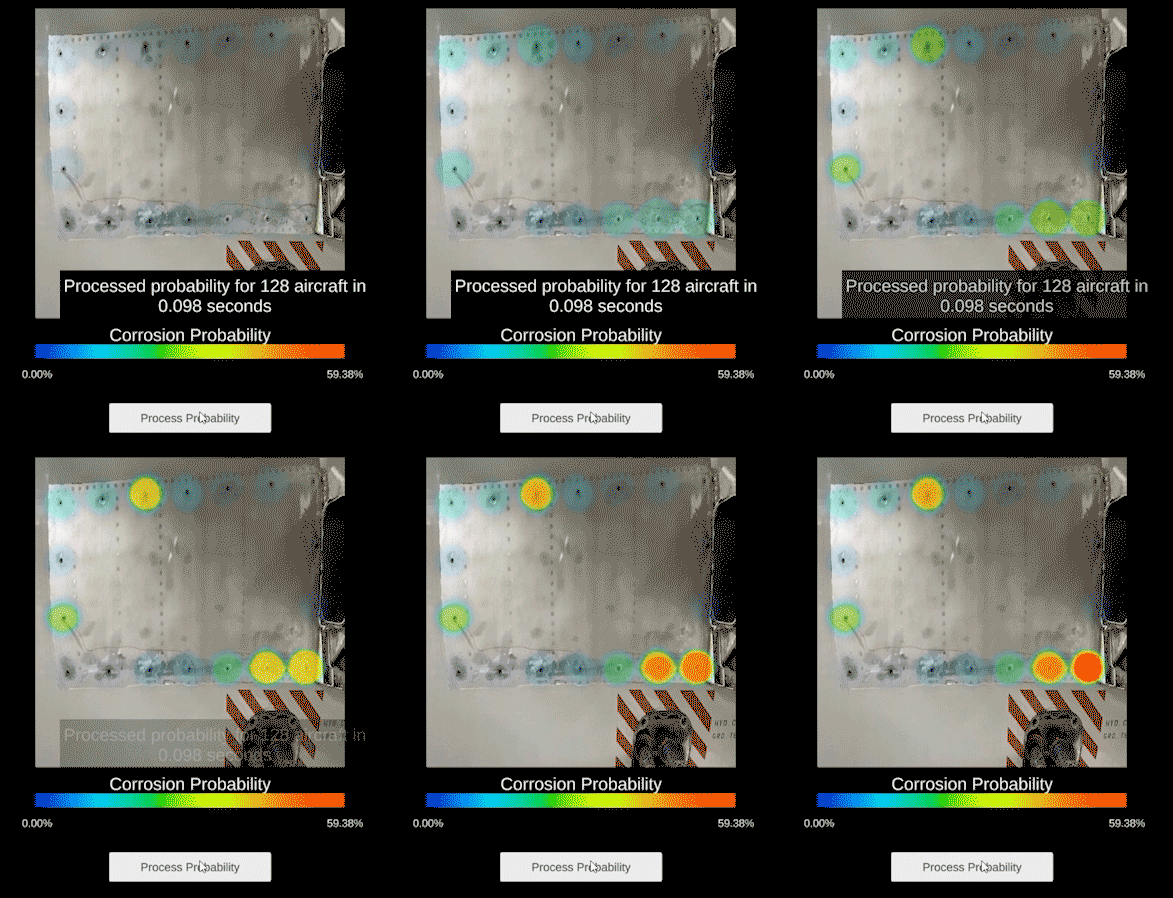
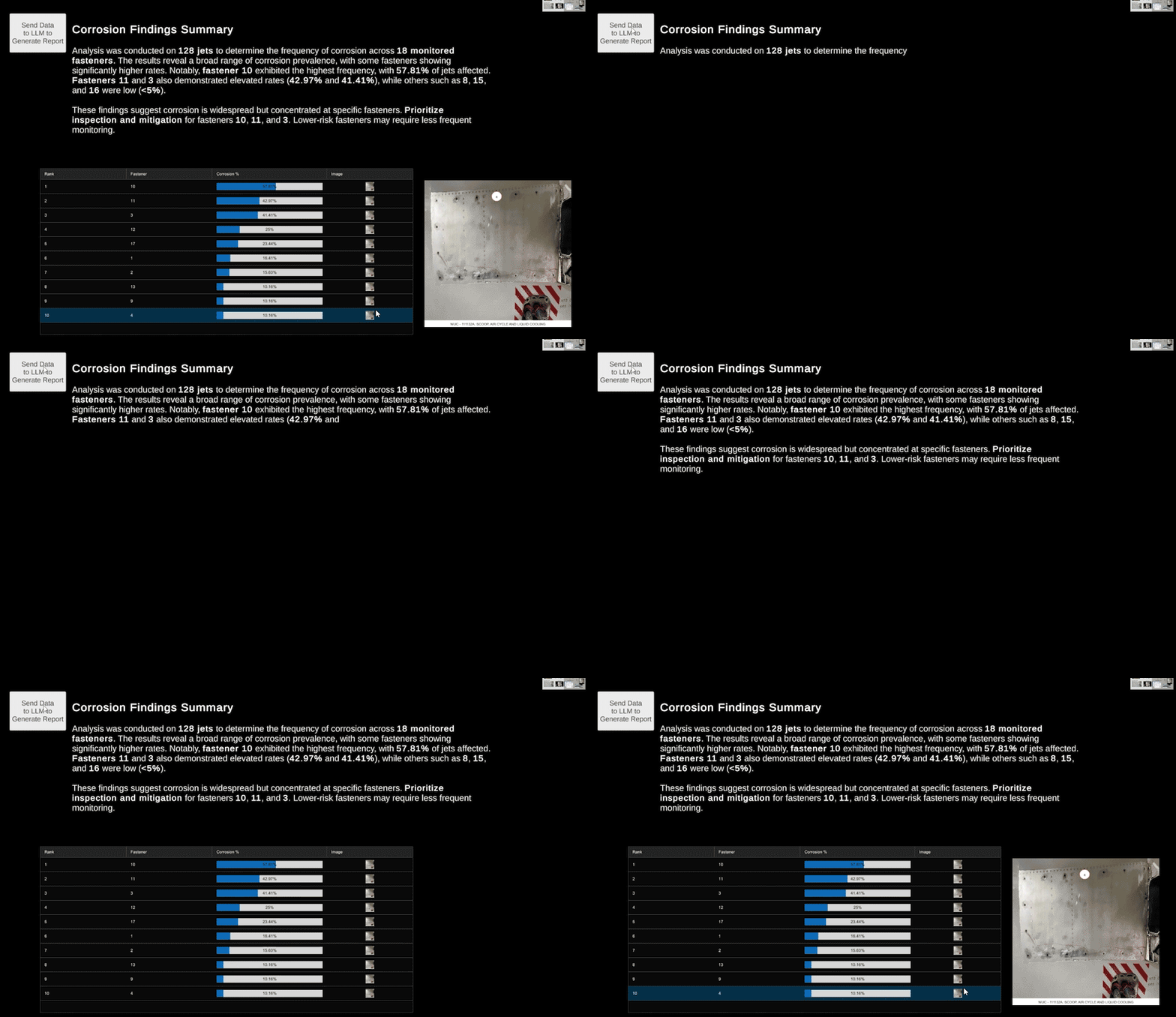
Corrosion probability analysis that turns field conditions into clearer operational context.
A structured operational view that supports future AI-enabled analysis and decision support.
Capability

Human-Machine Interfaces for Complex Systems

As machines, sensors, software, and AI become more capable, people need interfaces that make complex systems easier to understand and control. Humana Machina designs human-centered ways to interact with operational data, spatial environments, and intelligent systems.

When operational information is grounded in the system itself and located in space, mixed reality can guide maintainers or machines directly to what matters and help them act with more confidence.

Mixed Reality Guidance in Practice
A maintainer is guided through aircraft maintenance with augmented reality, using spatially located information to move to the right component and complete the right step.

How We Help

Our work usually starts with a real operational challenge: an asset that is hard to understand, a process that is difficult to maintain, knowledge that is at risk of being lost, or data that is not ready for the future. We help turn that complexity into structured, usable systems.

01

Capture assets

Collect spatial, visual, procedural, and operational information from the environments where work happens.

02

Structure knowledge

Organize expert knowledge, documentation, observations, and procedures into reusable digital formats.

03

Connect data to context

Link information to the physical spaces, assets, systems, and decisions it supports.

04

Improve decisions

Give teams clearer ways to understand conditions, coordinate work, and act with confidence.

05

Prepare for AI and autonomy

Build data foundations that can support intelligent tools, human-machine interfaces, and future autonomous systems.